

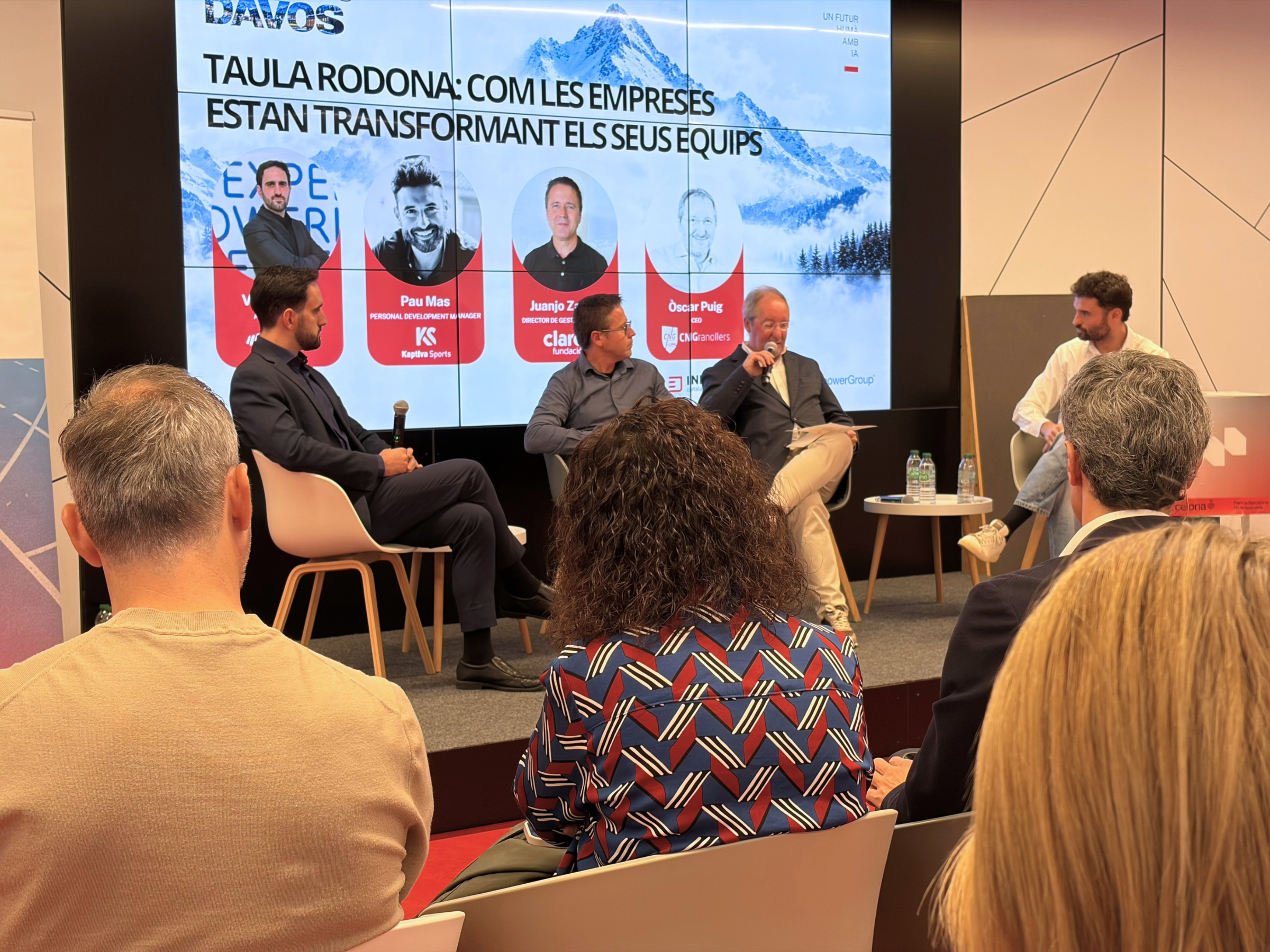
The «Rethinking Work at Davos» event, held at Ca l’Alier, brought together industry professionals to reflect on the macro trends reshaping the labour market and the future of people management.
Human and artificial intelligence, new ways of working, adaptability and generational succession are among the major challenges shaping the future of talent management. To explore these transformations and understand their impact on the sports industry, INDESCAT held the event «The macro trends reshaping today’s labour market: Rethinking Work at Davos» on 27 October at Ca l’Alier, in collaboration with ManpowerGroup, a member company of the cluster.
The session provided an opportunity to explore the findings of the international report Rethinking Work, presented at the World Economic Forum in Davos, with insights from Jordi Sardañés, Manpower’s Director of Operations in Catalonia. The report identifies 16 macro trends transforming the world of work, grouped into four key areas: hybrid superteams, the agility to adapt, changing rules of work and the talent succession crisis.
These trends are creating new scenarios for organisations and highlighting the need to rethink working models, professional skills and strategies for attracting, retaining and developing talent. The event also offered an opportunity to put the sports industry’s situation into perspective by comparing it with other sectors, including energy, finance and manufacturing.
Talent: a strategic factor in the competitiveness of the sports industry
One of the event’s highlights was a round-table discussion on attracting, retaining and developing talent, featuring Pau Mas from Kaptiva Sports; Juanjo Zabala from Fundació Claror; and Oscar Puig from Club Natació Granollers. The three professionals shared their experiences and insights into the main challenges sports organisations face when managing their teams and preparing for changes in the labour market.
Among the key takeaways, participants highlighted that high performance cannot be sustained without strong leadership and a genuine organisational commitment to people. They also stressed that investing in talent is essential to ensuring business competitiveness and long-term growth. Another key point was the need to move beyond a management approach focused solely on job positions and towards models that place greater emphasis on professionals’ skills, knowledge and expertise.
The session concluded with closing remarks from Enric Clarà, ManpowerGroup’s lead in Catalonia, and Anna Pruna, President of INDESCAT, who offered their final perspectives on the challenges identified and their implications for the sports industry.
Sharing knowledge to anticipate future challenges
The event concluded with a networking session, providing an opportunity for participants to exchange experiences and build new connections.
The initiative is part of INDESCAT’s Talent Working Group and reinforces the cluster’s commitment to supporting sports industry companies as they analyse the major changes affecting their development. Anticipating trends, sharing knowledge and promoting new people-management strategies are key to building organisations that are better prepared, more competitive and ready to face the challenges ahead.